Showing posts with label Field Study. Show all posts

Friday, November 11, 2011

Delaware Trip

Each year, the class goes to Delaware and always for the same reasons.  First and foremost, it enables the students to see the collections at Winterthur, the palatial estate that Henry Francis DuPont filled with arguably the finest collection of American antiques assembled under one roof.  The collection holds (by most estimates) about 85,000 objects and the house part of the museum (there are galleries as well) is divided into 175 rooms.  There is virtually no didactic material at all in any of the rooms (except for discretely placed binders with object lists and information)--instead, one relies upon the well-trained guides to take you through the house, inform you of the history of the collection, and place the furnishings into context.  I'm always stunned to see that there aren't more people at Winterthur on any given day.  It's easily accessible from NY, NJ, PA, and the Baltimore-DC area, and with 175 rooms, one can easily take tour upon tour finding new rooms, new displays, and noticing things you have never before seen.  It is an overwhelming tour each time, and I mean this in a good way.  DuPont's collection has a depth of materials that one cannot even begin to process and fully appreciate in the time allotted.


Our first day started with lunch at the cafeteria in the visitor center.  We were joined, as we have been in year's past, by a number of fellows from the Winterthur program, most in their second year, and anticipating the upcoming semester of thesis writing that awaits them.  From there, we took the garden tram tour over to the museum.  The grounds at Winterthur are as staggering as the collection.  Situated on close to 1000 acres of land, there is no way one can begin to process the extent of the land in a single visit.  Moreover, DuPont's sensitive plantings mean that each season the grounds take on a different character, as plants bloom in succession, and create a rich and variable tapestry of texture and color.


Although we arrived at the museum, our goal was to tour the library, see some of the special collections, and familiarize the students with the rich archival material that Winterthur holds.  In addition to the letters and papers of DuPont, including color photographs demonstrating the seasonal arrangements of rooms and their color schemes, the archives holds incredible treasures.  Jeanne Solensky, Librarian at the Joseph Downs Collection of Manuscripts and Printed Ephemera, did not disappoint.  Students saw a number of important primary sources, from the inventory of Duncan Phyfe, to a manuscript written (and even illustrated) by Thomas Sully, to employee payroll ledgers from Gustav Stickley's United Crafts in Syracuse.  This year's group was especially interested in the collections on hand, and so, without even meaning to, we ran a bit late.


Other highlights included a first edition of Thomas Chippendale's The Gentleman and Cabinet Maker's Director, a beautifully illustrated book of trades published in Germany in the 19th century, and photographs of DuPont's cows--they were prize winning cows and he seems to have taken a portrait of each one he owned. 

There are few things finer than seeing things first-hand.  Here, students are pouring over Thomas Sully's Memoirs of a Professional Life from 1851.  From the lower floor of the library, we were gathered up and headed upstairs to see the painting conservation laboratory and talk with Joyce Hill Stoner about her work, the work of students in the program, and some of the important discoveries she has made in her career.

The University of Delaware and Winterthur do an incredible job of training the next generation of conservators, of researching the most effective way to clean and protect paintings, and of making themselves accessible for educators and their students.  The projects we saw in process ranged from the cleaning and stabilization of an American late 17th to early 18th century regional portraitist, the cleaning of a French 19th century work (pictured above), and the incredible work they are doing to repair tears and structural damage in canvas.  It provides the students an opportunity also to see the differences in approach between commercial conservation and academic museum style of conservation.  


While both adhere to similar professional standards regarding the reversibility of any work they do, and an approach that fills in gaps but does not obscure the original artist's surface, the academic / museum world has a luxury of time and depth of investigation that is rarely available in a commercial setting.  Understanding both sides of the practice (or at least two discrete dimensions of it) gives students a better sense of the limits and concerns involved in painting conservation, and exposes them to a broader range of options involved in the field.

From there, we headed back to the hotel, checked in, and dressed for the opening night of the Delaware Antiques Show.  I like the Delaware show a lot, not only as a place to visit, but also because it provides an exceptional teaching opportunity for the students.  Not only do they see different models of business and get to engage the dealers and the materials directly, but they also see a different model of show--one smaller in scale than the Winter Antiques Show which they will work at in January.  It's also a lovely opening, and had I not run into so many folks who are friends of the program (Elle Shushan, Leslie Keno, Carrie Barratt, Amelia Peck, and Tom Savage to name a few).  I might actually have found the time to take pictures of the show.  I am certain that we'll find some and promise to post these right away.


Day two of our two day jaunt to Delaware began with a lecture in the museum's furniture galleries by Brock Jobe.  Brock is among the most generous of scholars: an expert in his field who goes out of his way to share his knowledge and who reminds students constantly of how much they have learned in the short time they have been with the program.  This year was no exception.  His lecture begins with a quiz, gathering a number of objects from the collection, allowing the students to examine and discuss them, but insisting that they identify form, region, maker (or thoughts on maker), and then give the rationale for this.  


Brock's sessions with our students always teach them the importance of connoisseurship, and stress the value of looking--something that too often art history programs either ignore or (because they never leave the classroom) are incapable of doing.  In addition, the whole idea of connoisseurship often gets a bad reputation, yet it is an essential skill to build and develop.  Unless you can assess the object you're studying and know about it--what's right or wrong with it / the difference between overpainting and original work, or have the ability to spot repairs and alteration--all of your studies are rooted in assumption.  I stress connoisseurship not as an end itself, but as a tool you need to possess so that whatever work you do beyond connoisseurship is rooted in fact and observation, not just belief.  
Knowing where and when a chair was made is important--not only for establishing the value of an object, but because this helps document the effects of commerce on regional styles, it allows us to better understand how craft practices moved through the colonies and nation, and helps create a network of ideas in which interchange and fluidity mark the period, rather than static regions with little or no communication.

Once the students have settled on their answers, Brock makes them present the evidence, discusses their work with them, and reminds them how far they have come in their ability to analyze and understand American material culture since they began their educations in September.  He is a wealth of knowledge, gracious, generous, and a highlight of each year's trip.  

From Brock Jobe we moved directly into the museum tour, many students seeing the depth of DuPont's collecting practices for the first time.  I have been to Winterthur half a dozen times probably, but am always surprised by how much I don't know, how many objects I have walked past that capture my attention, and how many rooms I walk into for the first time.  Although furniture and American objects are the focus of the collection, Winterthur has important holdings in paintings, prints, and pastels (a pair by Copley--his self portrait and portrait of his wife come to mind) that are displayed within the rooms.  Winterthur transcends the average house museum not just in its size (or the size of the collection), but in its depth, in the personal nature of each tour, and in establishing a context for American life that is unrivaled anywhere in the United States.  Unfortunately, you cannot photograph while on the tour, but to get a sense of what we saw, just go and visit.  It's about the best way to spend a day in Delaware. 

Sunday, November 6, 2011

Sotheby's in the South: Charleston Day 3

With day 2 behind us, and a little more tired from the activities than expected, I decided to make day 3 a little bit less full so that there would be no issues with missing planes, or running out of energy at the very end.  On our agenda for the day were 2 historic houses: the Nathaniel Russell House for the morning, followed by some free time to explore the city, then touring the Aiken-Rhett House in the afternoon.  We were to meet curator Brandy Culp at the Russell house that morning, but some bad weather delayed her in Texas.  In her place, we had a fabulous tour of the house with Bridget O'Brien, historic Charleston's museum coordinator, who deserves a lot of credit for stepping in (at the 11th hour no less) and taking us through the house and collections.


Unlike most of the museums in the northeast, where southern furniture and decorative arts are largely ignored, the Historic Charleston collections are packed with great objects.  And unlike period rooms, where I always feel a bit like I am moving through a series of dioramas, the museum-house allows you to experience the the architectural setting of the environment as a constantly changing backdrop.  This means that you see much more than a typical period room environment can provide: the way that light changes in the rooms, the fluid relationship between interior and exterior which opens up views and vistas on the yard and town, and the acoustic properties of the space, the shift in sounds that each room and transitional space brings.  As always, one of the highlights of the tour was getting to see the storage area--this type of access gives a good sense of what the museum holds, and always features items of interest to our group.  Bridget's tour was no exception, she took us into the storage spaces, discussed the various strategies of presentation of historical materials that the foundation employs, and gave us a preview of their upcoming work.


Knowing that I had some time to spare before our next house museum, I walked through town, looking into antique stores, grabbing some coffee, and wandering up towards the Aiken Rhett house.  Along the way, however, I made two stops: the Confederate Museum in Charleston followed by the Joseph Manigault House.


The Confederate Museum was not at all what I expected.  Frankly, I didn't know what to expect, but there was no amount of preparation for what I encountered.  It is a small, densely packed space, with cases of exhibits, paintings on the wall, cannons, maps, and uniforms.  What struck me as odd (and admittedly, I am a bit of an outsider here) was the complete lack of any didactic material.  My impression was that the museum took for granted your knowledge of the civil war, assumed a familiarity with soldier's and officer's names, and thus decided to provide labels that were informational / factual (i.e., here is what you are looking at) rather than explanatory.  I was particularly struck by the lack of mention of slavery throughout the museum, with the exception of an urban slave tag on display.  Perhaps I am cynical, but I took the label to claim that slaves were sometimes allowed to work, as if somehow this was enough explanation.  What happened to the wages, the treatment of the slaves by their masters, and indeed the whole question of servitude was neatly sidestepped.


By contrast, the Joseph Manigault house was a little more clear in its intention, and more didactic in the presentation of materials to the public.  Part of this is achieved by requiring a guide for all tours, who leads you through the home's history, introduces you to the families involved, and provides information about the pieces in the collection.   Although in some sense your experience is dependent on the guide (and thus not guaranteed or necessarily repeatable), the guide I had was pleasant and knowledgable.


The museum features one of the nicer portraits by Swiss Painter Jeremiah Theus that I saw in Charleston, as well as beautiful gardens and architecture.  The collection is not quite a strong (on the whole) as the Museum's Heyward Washington House, but it does provide an additional layer of depth towards understanding the cultural, decorative, and architectural heritage of the city, and should be on anyone's list of museum to see who visits the city.


The last stop of the day for the class was the Aiken Rhett House, which provides a stunning contrast to Historic Charleston's other property (the Nathaniel Russell House) and shows the true depth of the foundation's didactic tools, as well as the range of its mission.  Unlike the Nathaniel Russell house, where all tours are guided, the Aiken Rhett House is an audio tour, and one which (I have to confess) I didn't hear.  The goal in the house was to have the students take the tour, then reconvene with curator Brandy Culp and me, to debrief.  What did they like about the tour?  What worked?  What didn't?  What did they want more of?  Less of?  In some ways, this (in addition to broadening the range of culture we cover) is the fundamental goal of this year: speaking to your audience.  While the students took the tour, I examined one of the museum's paintings, and then sat in on a conservation meeting discussing possible steps and strategies.


After the conservation meeting, but before our debriefing, I talked to the students briefly about the conservation plans, some of the issues with the painting, as well as the logistical issues of the conservation. Then, I went to the basement, awaited the students and the debriefing / question period began.  I was incredibly surprised by the depth of the students questions, the issues they raised, and the thoughtful critiques (both positive and negative) they gave of their tour.  While it would be difficult to say there was consensus on the issues, it was remarkable to me how keenly the students hit on major points, how sharp their eyes and observations were, and how much they had absorbed in the short time they had spent in the program.  One of the reasons the program has stressed connecting with audiences as a theme, is that it is a skill applicable to a wide range of careers open to students upon graduation.  Whether you decide to write, pursue a PhD, sell objects, work in museum education, work in development, or provide consultation services to collectors, the fundamental task of connecting with the audience remains the same.  Without this skill, the ability not just to repeat the facts, but to forge a connection and understand (anticipate even) the needs and desires of the audience, remains a paramount indicator of future success in the art world.  Based on what I saw in Charleston, and in Boston, and in the classroom, I have great confidence that this year's group of students will do exceptionally well.  

Thursday, October 27, 2011

Charleston: Sotheby's in the South Day 2

If day one was supposed to relax and acclimate the students, then day 2 was supposed to give them a total Charleston Experience.  We had a rather ambitious schedule to follow with the following events planned:

  1. City Hall Portrait Collection
  2. Drayton Hall
  3. Lunch
  4. Gibbes Museum of Art
  5. Heyward Washington House
  6. Charleston Silver Vault reception
We started early, and arrived at City Hall right about 9:00 AM.  Once we made it through the security check and metal detector (there was a wand at this one in addition to the walk through) we took the elevator up to the second floor to see the portraits.  This might be one of the hidden gems in Charleston: I have only been twice but each time there were few people.  Considering the collection boasts important portraits by John Trumbull, Charles Willson Peale, John Vanderlyn, Samuel F. B. Morse, and GPA Healy, it is a wonder this is not on more people's radar.  We were met by the tour guide, who is an eager and lively student of history.  She knows the figures in the painting well, is versed in Charleston history, and has a dramatic flair to her presentation that is often amusing.  She appears to be quite taken with Healy's portrait General Beauregard (seen in the image below), who apparently was regarded throughout Charleston as quite handsome.

 Just below the painting is a case containing Beauregard's sword--the very one seen in the image. 

The centerpiece of collection is the portrait of Washington by John Trumbull, and the story associated with its commission.  Originally, the portrait of Washington at the Battle of Trenton (presently at Yale) was delivered to the city but refused.  Why?  Well, the rumor is that Charleston wanted a picture of Washington with some connection to Charleston, and that the Battle of Trenton (as important as it was) just didn't appeal to them.  David Bjelajac, in American Art: A Cultural History states that the town thought Washington looked too severe--not approachable or welcoming enough--but the guide tells a different story.  According to this version, the positioning of the rear facing horse (its most notable attribute above the skyline and the mayor and councilmen pictured in the middle ground of the painting) was Trumbull's revenge (as the painting is sometimes referred to in Charleston).  

We made it through the galleries and then were on our way back to the hotel to catch the bus that would take us to Drayton Hall.


Drayton Hall is the finest piece of Palladian architecture built in the United States, and it is difficult to imagine the impact this would have made upon visitors arriving in the 18th century.  Situated along the Ashley River about 15 miles outside of Charleston, it was built for John Drayton from 1738-42.  We arrived a bit early, and after a quick jaunt through the gift shop met up with Carter Hudgins, the Director of Preservation and Education.  Carter's work at Drayton Hall is exceptional and the discoveries that they have made there--from fine pottery the likes of which are not seen anywhere else in the colonies, to remains of the original porticoes that flanked the house originally--will force a dramatic reevaluation about life and culture in the southern colonies.  Although the house has no furniture, he brought with him photographs of what is known from the family and let us know where it could be seen in Charleston.

  
From there, we joined up with Debbi Zimmerman, Drayton Hall's Group Tour Coordinator who took us through the house.  It's quite difficult to describe the impression the house makes upon you when you enter: it is at once majestic and tragic.  The majesty of the rooms and the intricacy and expense of the carving are overwhelming.  I suppose it is the home's emptiness, the quietness, and the realization that people do not build with this degree of elegance anymore that accounts for the tragic side of it.  In fact, the house is so beautiful unfurnished, so elegantly planned and realized, that it is difficult to imagine it furnished.  The effect must gave been overwhelming when it was occupied.


Although the rooms can be generally divided, by the amount of decoration and their location in the plan, into private and public spaces, the attention to detailing, the carvings, and the ceilings make each space individual and quite special.  

The carvings in the great room on the first floor are impressive and original to the house's construction.  The alternating floral motif used in the frieze of triglyphs and metopes creates a pleasing rhythm that carries throughout the room.


This ceiling is later plaster work and a good example of Drayton Hall's mission to preserve and stabilize the structure and its many layers of history rather than attempting to strip it back to a single interpreted point in time.  The result is a complex and woven history that allows interpreters to discuss the building as an original structure without ignoring its one history of use and even modification.    

No one seemed entirely certain what the overmantel carving was supposed to represent: a fox? a boar?  Likely taken from an English pattern book, the carving nonetheless testifies to the strong ties that rural plantations had with high style English design.

Light and sound are among the most important features of a building that virtual tours, and slides, and even books cannot convey.  One reason we make it a point to travel is because architecture, perhaps more so that any of the other arts, demands that you experience it in order to make sense of it.  Sitting in this room, the sense of balance, the proportions and the scale are not just seen, they are felt and absorbed. 

It's easy to overlook small details, or to leave a room wondering how exactly the sense of a totally designed space was conveyed to you from the moment you entered.  The carving of the volutes, the vegetal forms that spiral outward, the egg and dart molding and the central rosette--these are the types of things that, even when not remarked upon, help to define a space and aid in shaping the impression of a space from the moment you enter.  That level of detailing, whether in a carved capital or a stair riser, is essential to the building's effect.  


It was, in many respects, a perfect morning at Drayton Hall.  A bit chilly (especially for the locals) but clear skies and bright sun.  This is a view looking down towards the main entrance over a circular earth mound that was created during the dredging of ponds in the Victorian period.  These layers of history are particularly well preserved at Drayton Hall and allow for a much broader discussion of social and cultural history than in many institutions.

If there was one bad thing about Drayton Hall, it is this: we had to leave.  One could easily spend far more time there than our group did, but the day was progressing, lunch was necessary, and the Gibbes Museum of Art awaited.

The Gibbes is a lovely museum, and I say this knowing that when we visited only a part of it was open as exhibitions were changing.  Even with that in mind, their exhibition "The Charleston Story" is a beautiful and worthwhile addition to any visit to the city.  The museum has strong holdings: a beautiful portrait of Thomas Middleton by Benjamin West, some lovely works by Henry Benbridge, a delicate and charming pastel by Henrietta Derring Johnston, and a number of paintings by Charleston's Jeremiah Theus, a swiss born painter who settled in the city in the mid 18th century.  The surprise for me was the stunning portrait of Robert Gilmor, jr. by Thomas Sully after Sir Thomas Lawrence.  Even though Sully's work is a copy, he captures the sense of light, the crispness of the collar, the moisture in his subject's eye's to such a degree that it is shocking.  The figure's anatomy has more strength and structure than I usually associate with Sully's portraits of this period, and it is among the finest paintings I have seen by him.  There is a depth and clarity to the work that leaves no doubt that Sully is a masterful painter and solid technician.

From the Gibbes we made our way down to the Heyward Washington House, one of the two historic properties owned by the Charleston Museum, and as luck would have it, Grahame Long was sitting outside and eager to take us through the collection.  Built in 1772 by Daniel Heyward, the house was rented to George Washington in 1791 for a week, and has been known ever since by its dual name.  It would be unthinkable to be in Charleston and not see the house, especially since the collection includes pieces original to Drayton Hall.  


The star of the house (aside from the European pieces the Drayton's owned) is undoubtedly the Holmes-Edwards bookcase.  Much of what we know about the bookcase and its attribution to the Pfeninger Shop in Charleston is due to an article by Thomas Savage that appeared in the Chipstone Journal American Furniture.  Far from being something produced in a minor way at the periphery, the Holmes-Edwards bookcase is a testament to the skill of southern craftsmen, and also to the diverse nature of immigration in the south that helped to shape its culture.  At various points in its history, the bookcase was believed to be English which underscores the types of regional bias that permeated scholarship.  The unspoken implication, of course, was that Charleston was too rural, too southern to make a case this fine.  The evidence indicates otherwise.

We finished the day with a delightful wine and cheese reception hosted by Al and Charlotte Crabtree of the Silver Vault of Charleston.  In addition to being Charleston's premier dealers of American and Continental Silver, the Crabtrees are gracious hosts, kind with their knowledge of silver, eager to discuss business questions that students had, and allowed us to handle pieces and examine them closely.  In addition, Al is a talented silversmith and restorer, with a broad knowledge of the history of silver, the curators in the field, and the auction world too.  It was exceptionally kind of them to welcome us into their shop, and a perfect end to a long and full day.

Charleston: Sotheby's in the South Day 1

It's become increasingly aware to me in my time in New York City how the location of our studies determines, at least in part, the types of objects we discuss.  One of this year's initiatives was to broaden the discussion, to pay more attention to regional productions outside of the main centers (like Boston, Newport, Philadelphia, and New York in the Colonial period) so that students emerge with a better understanding of the textures and complexity of American culture.  While many at the Met still shudder to remember Joseph Downs' 1949 statement that "little of artistic merit was made south of Baltimore," one might reasonably ask what is being done to correct that stance.  I should point out too, that the bias Downs articulated was neither exclusive or particular to the Met, it seems part of a broader, largely unspoken notion that impacted collecting habits throughout the northeast.  Unfortunately, it is still virtually impossible to see any quantity of southern furniture in New York City (or Boston, or Philadelphia for that matter); this is a serious lacuna in these collections.  Fortunately, it provides an excellent reason for our program to travel south, out of the reach of Manhattan's autumn, and into Charleston.


Arriving as we did in the late morning, the first day was designed to allow students to get their bearings, get situated in the hotel, eat at one of the many fine restaurants Charleston has to offer, and then gather at the Charleston Museum for an overview of the art and culture of the region.  I'll be honest: this should be the first stop for everyone who goes to Charleston.  The museum is pleasant, incredibly informative, and acclimates visitors to the culture of Charleston perfectly.  The permanent exhibition in Lowcountry History Hall takes you through the history of Charleston starting with the settlement patterns, the regional agricultural concerns, demonstrating how the economy developed, details Charleston's involvement in the Civil War, and functions as the perfect primer for any visit.


We then met with Grahame Long, Curator of History, in the Loeblein Gallery of Charleston Silver.  The museum's collection is tightly focused and contains some really unexpected gems.  Want to see George Washington's christening cup?  They have it.  They also have a wide range of objects--from Colonial Gorgets, to 20th century spoon dies, to contemporary pieces like the beautiful bleu cheese bowl by Charleston silversmith Alfred Crabtree.  Grahame Long is exceptionally knowledgeable and accessible, and explained the purpose of the installation, the goals of the collection, and brought objects out for the students to handle.


 Probably the highlight of the silver gallery was when Grahame removed a number of slave tags from an envelope, placed them atop the vitrine and asked the students which ones they thought were authentic, and which ones they felt were fake.  


As it turns out, all of them were fake, which was good as none of the students were wearing gloves.  What ensued, however, was a discussion of authenticity: how does the museum guard against fakes coming in, what do they do when they find fakes, and how does one go about making the assessment.  Interestingly, the museum keeps fakes like this, which forms a useful tool in examining and authenticating works.  It also allows them to use these objects as teaching tools, informing both the public, students, and even collectors about things to be wary of.  From the silver gallery, we headed back into storage to see the nuts and bolts of the museum's operation.


The Charleston Museum is in fact the country's oldest.  Founded in 1773, essentially as a satellite to the British Museum, their mission has evolved over time, and much of that evidence remains in their storage facilities.  While there we saw virtually everything: from Ivory Billed Woodpeckers, to Demming and Bulkley Tables, to their "wet storage" rooms--a collection of specimens in bottles, ranging from fish to snakes to unmentionable things kept in locked boxes.  


It was fascinating.  Disturbing at times, but fascinating nonetheless.  Where else in America could you spend the morning looking at George Washington's christening cup, the afternoon seeing extinct birds beautifully preserved, and your free time seeing squid, fish, and animals from around the world still preserved?


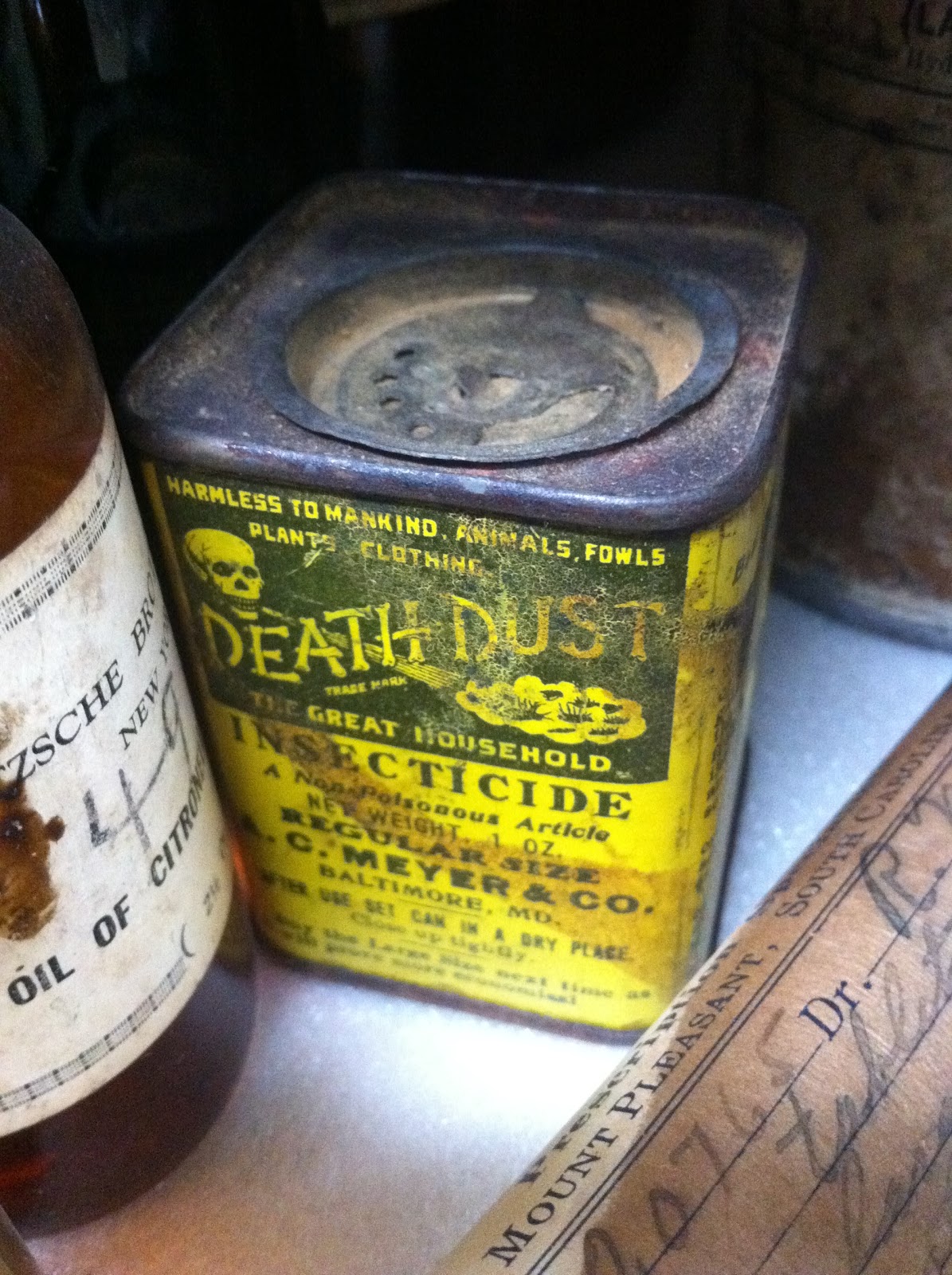
From wet storage we moved back into the dry things, and were treated to the museums impressive collections of material culture.  One thing students began to understand was how the mission of the museum dictates its collection policies and helps shape the scope of the collection.  Unlike fine art museums in which the focus is on art, The Charleston Museum is focused on educating people about Charleston: its history, its culture, its productions.  This means that not only are the strategies for display different, but their didactic materials must be broader and able to speak to a wide range of audiences.  It means they collect everything from the finest Charleston Silver to the quirkiest of insecticides, all because these each have a place in telling the story their mission dictates.


Grahame Long was generous with both his time and knowledge, and a splendid host.  We will certainly make the museum a regular stop when we travel to Charleston.


Yale Day Trip

On October 11th, the class traveled to New Haven to visit Yale University's Art Gallery and the Furniture Study center.  Arriving early at Grand Central (7:00 AM) we managed to get tickets, coffee, and prepare for our time in New Haven.  Yale is a trip we take each year that I am particularly fond of, even more so this year because highlights of their American collection (including John Smibert's Bermuda Group) were out on view.  The train ride from Grand Central is fairly easy and well worth the time it takes to see the museum.  In years past, because of the museum renovations, we focused on the Center for British Art and the furniture study center.  This year, with a full schedule and much to see, we never even set foot inside the Center.


Our first stop was to the Museum to see selections from the permanent collection installed (If memory serves me) on the Third Floor.  For Americanists, there is a great blend of important Fine and Decorative Art.  Highlights for the group included seeing Benjamin West's Aggripina Landing at Brundisium with the Ashes of Germanicus from 1768.  Although a standard image in every American survey, the size and scale of the object allowed West to render a level of detail that is impossible for slides to capture.  I think it's easy to forget how good a painter he was, how much control he had, and how much he included when looking at a projection of the image.  Installed across from Copley's Mrs. Benjamin Pickman of 1763, the gallery serves as mini-survey of American painting, allowing students to see representational works by the key players of the era.   


Yale's gallery deserves a lot of credit for showing works that aren't typically seen in smaller museums, such as the charming Aesthetic Movement vignette which included a beautiful John Bennet vase.  They also display a Stickley sideboard with ceramics from Marblehead Potteries, Dedham, and Roseville.  


From the Art Gallery we headed to the furniture study center to have a silver handling session.  Although we were scheduled for about an hour of time on silver techniques, condition, and construction, the generous staff at Yale let us run over as students continued to ask questions, examine objects, and take notes.  Once the required white gloves were on, students were able to handle the objects, ranging from a mug made by silversmith John Coney from about 1710-15, to an 1880 silver ingot from the Free American Mines, to tools silversmiths use in their trade. 


Having discussed the basics of silver manufacturing, general issues of condition, and how to determine what methods were used in the making of pieces, we broke for lunch which everyone found on their own.  

Normally I have little interest in detailing my meals, but the trip to New Haven requires a break from tradition here.  For it is in New Haven, according to some food historians, that the Hamburger was born at Louis' Lunch.  Housed in a small, unassuming building on Crown Street, the menu options are limited: you're pretty much there to eat a burger.  Grilled in a proprietary gas fired contraption, the meat is served on toasted white bread, not buns.  Everything is made to order, and seating is limited.  The burger was fine, not the best burger I have ever had (and a tad undercooked), but the place oozes history and was a nice break from the outdoors.


After lunch we met up again at the Furniture Study Center for round 2: wood.  Yale provides exceptional access to the collection in a way that most Luce center installations cannot.  There's literally no barrier between the object and the viewer, and our hosts were more than happy to remove drawers so that students could see secondary wood types, better understand regional construction differences, and fully appreciate the objects.


The center's collection is arranged chronologically by type with regions typically grouped together as well. It's a stunningly obvious (at least in hindsight) way to organize furniture that makes so much sense because it allows for concentrated masses of objects that enable the viewer to pick out similarities and differences.  Distinctions between makers and regions and wood become more obvious because of the proximity and it is one of the best teaching tools available.  The collection spans from the 17th through the 20th century and includes desks, chairs, tables, clocks, bureaus, and virtually anything else one could desire.


After we finished we furniture we went back to the Art Gallery to view the current exhibition: Life, Liberty, and the Pursuit of Happiness: American Art from the Yale University Art Gallery Part One: We the People. On view from July 29, 2011–January 1, 2012, the exhibit is full of revelations. Smibert's Bermuda Group has never looked so clean and vibrant, and--positioned close to Copley's miniature of Reverend Samuel Fayerweather and Peter Pelham's mezzotint of Cotton Mather--forms a microcosm of the arts in Boston before 1760. In addition to the high art tradition of painting, regional and folk painting was well represented too with incredible paintings by The Beardsley Limner, Edward Hicks, and the enigmatic portrait of Roger Sherman by Ralph Earl. Even in a relatively small exhibit, Yale demonstrates a surprising amount of strength and depth to their collection: miniatures by John Trumbull, a version of Hiram Powers' The Greek Slave, a beautiful portrait by John Neagle, and a striking painting by Fitz Henry Lane.  The arrangement of the exhibition, by blending different media, and juxtaposing objects of different sizes makes for a dynamic viewing experience.  It also reinforced the context within which objects were made by causing a dialog between the prints, paintings, furniture, and silver.  Part two of the exhibition opens on January 31, 2012 and if the first installment is any indication, this will be well worth another trip up. The catalog accompanying the exhibition is beautifully done, comprehensively researched, and well worth the price.

Boston Trip: Day Three

Thursday was our last day in the city, and a little more sparsely populated than the previous days.  The morning started with a trip to Vose Galleries, the oldest dealers in American Art still in business.  Vose has always been a family affair, and that tradition continues today.  On the morning we arrived, the Voses were expecting another addition to the family to arrive that afternoon and it seems as though the family business will continue well into the future.  Students spent time on the galleries three floors, examining a range of works from Heades to Homers to contemporary pastels.  In addition to being able to examine works close up and see different styles of framing, we also heard a bit about the business side of the market: how works come into the gallery, how the market has shifted in the past decade, strategies for client services and cultivation, and the impact of the internet on marketing and sales.  The Voses and their staff were extremely generous, and we were grateful for the time we spent with them.

The gallery is housed in a brownstone on Newbury Street, which allows you to get a sense of scale and proportion of the works in a way that's impossible in a larger, more sterile space.  

If you'd like to know more about the Voses, their inventory, and exhibition schedule, click here


After the gallery visit, we headed over to the gold-domed State House, built by Charles Bullfinch with subsequent renovations and additions.  
It's an impressive building, the tours are free, and even though one must pass through metal detectors to enter the building (which always delays a group somewhat), it is well worth a visit.


Here's our group at the entrance.

Personally, I found the classical restraint of the Bullfinch sections to be the most elegant portions of the building, although the exuberant later work was interesting, too.  One reason we decided to take this tour was so that students could see the difference between Bullfinch’s residential work and his civic commissions.  Between this and the Otis house, we were able to see many examples of Bullfinch’s work, from the differences between public and private space in a residential setting, to public commissions designed to be both functional and ennobling. 

One of the stranger (and less visually successful) elements of the tour was an enclosed courtyard that was used for press conferences and events.  If there was any complaints I had about the building, it was the disjunction between styles and the varying quality of the design.  
The ceilings are one of the best parts of the tour, despite the limited attention they receive. 


Although aspects of the Victorian addition were quite nice, the blend of this, with the Bullfinch and Michael Dukakis' mid to late 1980s, worked against a feeling of cohesion.  Whereas the Bullfinch sections really stood on their own as great spaces, the newer additions were less satisfying.

Statue of a Civil War Nurse and Wounded Soldier, given to the State by the Massachusetts Daughters of Veterans in 1914.  On the wall behind this statue are plaques honoring Clara Barton and Second Lt. Frances Slanger.  


From there, it was a short walk across the street to the Robert Gould Shaw Memorial, sculpted by Augustus Saint-Gaudens.  


The creation of the monument and its subsequent history seems to tell an important piece of the Civil War and race relations in the United States.  Shaw, who commanded the all-black 54th regiment is honored by this piece, as are the five white soldiers who were killed during the battle of Charleston Harbor, and although the black soldiers appear in the scene, they remained nameless until they were included on the monument in 1981.  Adding insult to injury, the 54th regiment was also paid less than white regiments, despite being brought into the war with the promise of equal pay.  It would be 18 months (and only after refusing all pay if it was not equal pay) that the soldiers received their full salaries. Critics have often remarked that Saint Gaudens’ sensitive treatment of the men in the company and individualized portraits used for the figures prevents them from becoming faceless, generic figures. 

Tuesday, October 25, 2011

Boston Trip Day 2

Day 2, like day one featured an ambitious schedule: a morning meeting in the hotel’s conference room, then to The Harrison Gray Otis House (10:00), Paul Revere House (11:30), followed by lunch and the recently reinstalled Art of the America’s Wing at the Museum of Fine Arts Boston (2:00).

The Otis House is wonderful and maddening: wonderful because the architect was Bullfinch and maddening because they won’t allow photography in the interior.  It’s also wonderful because they make you wear shoe covers so there is no mistaking the fact you are in an important space that requires special considerations. 

The Paul Revere House has a much different style of interpretation than the Gray House, preferring a more generalized period approach to a time specific one.  I got the impression that this difference was less a failure on their part than something ingrained in their mission.  


The house is small, but charming.  

Here we are lined up to go in, enjoying a respite from the sun 


Unlike the Otis House, where the primary emphasis is on the art and architectural setting, at Paul Revere’s house it is the man himself that is the draw for most of their crowds. Instead of using the house to explain the aesthetics of the period, the house becomes a tool by which to understand the man.  Most people who walk through—or at least those that did when we were there—do not seem to mind the jumble of styles evident in some of the displays and did not notice the varied states of condition and restoration on the objects.  In many ways, theses details get lost under a veil of acceptance of “Colonial Style” and are never questioned.  It’s unfortunate in some ways though, since it would seem relatively easy to teach the staff about the objects in the rooms, and a better consistency of styles might help educate the public subtly (through visual cues) and allow for multiple ways to interpret the space.

The Art of the Americas wing was the highlight of the day for a number of reasons.  First, Gerry Ward the curator of Decorative Arts kindly took us through the galleries, discussing both the objects in the rooms and the types of decisions made regarding the installation and audience engagement.  


Secondly, it has been a tough few years for American Paintings since the Metropolitan Museum is renovating, as is the New York Historical Society.  To be able to see a critical mass of early American Works is a treat, and the Museum’s collection is exceptional.  I also liked the building much more than I imagined I would.  To be certain there were quirks—connecting passages that don’t exactly form a coherent or welcoming transition between disparate galleries—but the building really works.  It let the galleries and the artworks shine, rather than the architect in charge.  It was a nice display of restraint to create something so practical and elegant that allowed the collection to shine.


Looking at furniture in the galleries


Efforts were made throughout the wing to provide context for viewing objects

Throughout the galleries, there were times in different states (some opened, some closed) which I found useful.  Small touches like this made the objects seem less like sculpture and gave a better context to these objects' functions and allowed for different levels of engagement with the material.


Object study and seeing works in person is a crucial part of our educational philosophy.  In hindsight, I am surprised at how little engagement with objects my own education had.  The static nature of slides, and their tendency to make everything seem similarly sized and scaled, presents problems that aren't easily remedied.  While slides are great for plotting the narrative of history, they seem a woefully inadequate substitute for seeing objects up close and being to move around them.  

Gerry Ward was generous with his time and knowledge, making the visit truly exceptional


The museum's holding of Copley's works is particularly impressive.


I also thought that the arrangement of the galleries (essentially a chronological walk through time) worked well.  One might complain that it lacked excitement, or wasn’t original, but it seems to me that this is a perfectly fine approach and one that helps reinforce the museum’s educational mission by providing an accessible narrative to follow.  I particularly liked the use of wallpaper and curators’ efforts to provide context for viewing objects.